
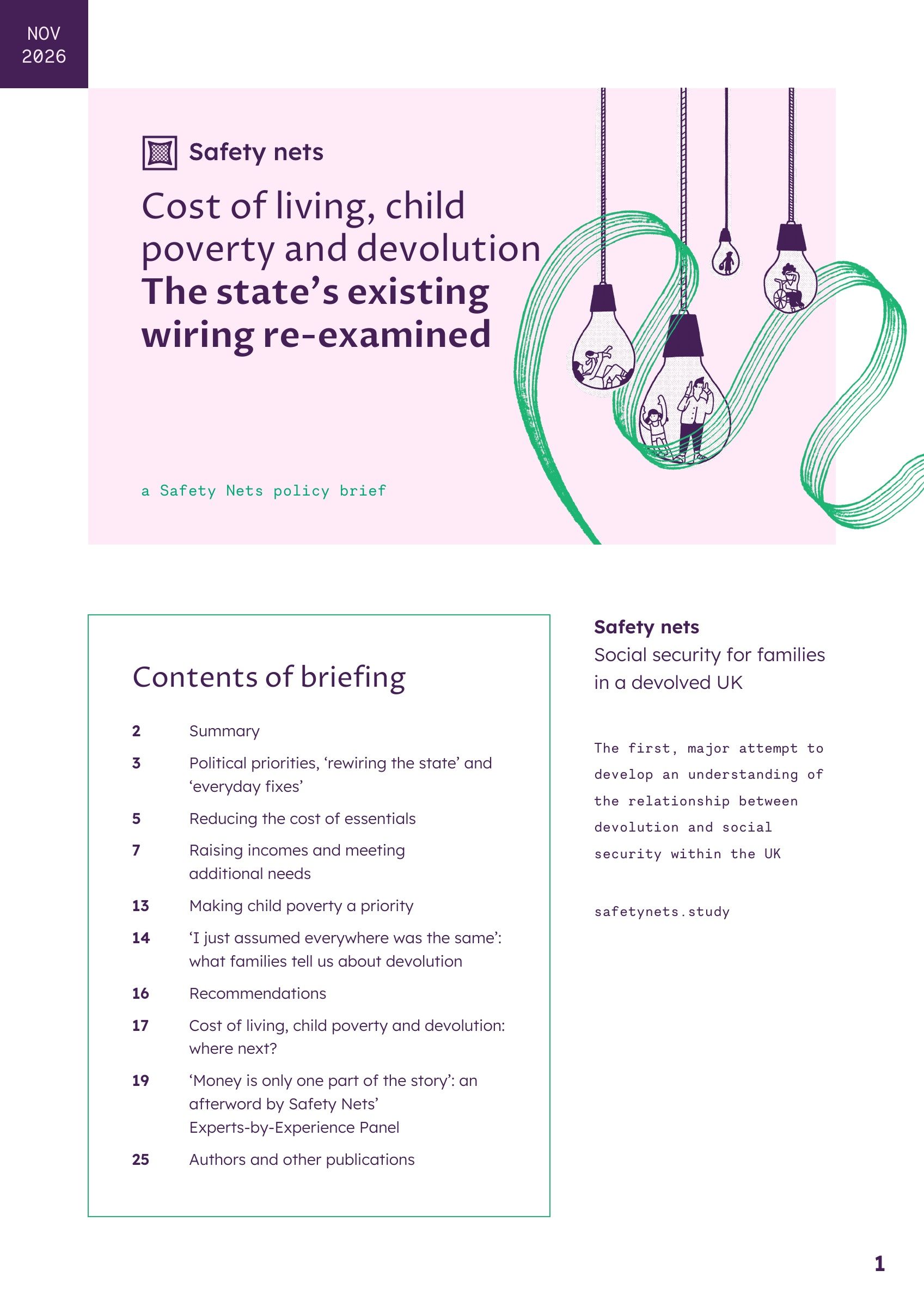
Briefing
Cost of living, child poverty and devolution
The state’s existing wiring re-examined
Published 05 November 2026
- The continued cost of living crisis and the Westminster government’s radical plans for greater devolution in England make it vital to better understand how the existing distribution of powers across the UK already shape support for families on low incomes.
- This report draws on new research to examines how governments and local areas across the UK reduce essential costs and increase household incomes, as well as documenting the variation between different parts of the UK.
- Insight from discussion groups with parents and carers from all four countries of the UK reveal that families know little about the differences between nations and frequently view postcode-based inequalities as profoundly unfair.
We make five key recommendations for any plans to further devolve social security, with wider relevance for the ‘rewiring the state’ agenda:
- Devolution and localisation need a strong UK-wide floor
- Funding must follow responsibility,
- Governments should distinguish between entitlement and discretion,
- Devolution should be designed with families, not simply for them,
- Evaluation should focus on outcomes and experience,
As the UK government develops its devolution programme, these principles can help ensure that transferring power strengthens the social safety net, improves accountability and supports efforts to reduce child poverty across the UK.
The research, and the findings that emerge from it, are guided by our Experts-by-Experience Panel, twelve parents in receipt of social security, three from each nation across the UK. You can read more about the work they been doing together in their afterword.
Downloads
Authors

Dr Kate Andersen
University of York

Dr Hayley Bennett
University of Edinburgh

Prof Mike Brewer
Resolution Foundation

Kim Carter
University of Glasgow

Alvina Tamara Chibhamu
University of Glasgow

Alex Clegg
Resolution Foundation

Tonia Dunn
University of Glasgow

Dr Ciara Fitzpatrick
Ulster University

Dotty G
University of Glasgow
Katy Gillespie
Glasgow Caledonian University

Dr Evie Heard
University of Glasgow

Prof Rod Hick
Cardiff University

Dr Annie Irvine
University of York

Gordon Jamieson
University of Glasgow

Dr Uisce Jordan
University of Glasgow

Tom Lee
Child Poverty Action Group

Christine McCrea
University of Glasgow

Dr Jed Meers
University of York

Dr Joe Pardoe
University of Salford

Prof Ruth Patrick
University of Glasgow

Dr Sioned Pearce
Cardiff University

Dr Maddy Power
London School of Hygiene and Tropical Medicine

Zahida Purves
University of Glasgow

Caroline Rice
University of Glasgow
Samantha Richards
University of Glasgow

Mhairi-Jean Ross
University of Glasgow

Prof Lisa Scullion
University of Salford

Dr Mark Simpson
Ulster University

Rhiannon Sims
Heriot-Watt University

Rebecca Stacey
University of Glasgow

Prof Beth Watts-Cobbe
Heriot-Watt University

Dr David Young
University of Salford

Charlotte Zealley
University of Glasgow
05 November 2026 //
Latest research